*All images are representations of the work that was done.
*All images are representations of the work that was done.
Senior UX Designer
compliance
200K users
Multi-persona
Built for a million guests. Broken for the staff serving them.
Built for a million guests. Broken for the staff serving them.
Built for a million guests. Broken for the staff serving them.
Smart Access is JPMorgan Chase's global intranet tool for requesting physical building access across countries and thousands of locations. I led the UX redesign: modernizing the experience, working to closing a deep knowledge gap, adding new functionality, and building analytics infrastructure from zero.
Smart Access is JPMorgan Chase's global intranet tool for requesting physical building access across countries and thousands of locations. I led the UX redesign: modernizing the experience, working to closing a deep knowledge gap, adding new functionality, and building analytics infrastructure from zero.
Smart Access is JPMorgan Chase's global intranet tool for requesting physical building access across countries and thousands of locations. I led the UX redesign: modernizing the experience, working to closing a deep knowledge gap, adding new functionality, and building analytics infrastructure from zero.
1M+
1M+
1M+
guests managed annually
guests managed annually
1,000+
1,000+
1,000+
locations on one foundation
locations on one foundation
85%-91%
85%-91%
85%-91%
satisfaction post-redesign
satisfaction post-redesign
Chapter 01 · My role
My role
I led the end-to-end design, from standardizing the check-in foundation across 1,000+ locations to redesigning the dashboard and guest detail view. I partnered with a UX researcher on interviews and concept testing, and worked directly with business, product and security stakeholders to introduce new features like ID verification without breaking the existing workflow.
I led the end-to-end design, from standardizing the check-in foundation across 1,000+ locations to redesigning the dashboard and guest detail view. I partnered with a UX researcher on interviews and concept testing, and worked directly with business, product and security stakeholders to introduce new features like ID verification without breaking the existing workflow.
I led the end-to-end design, from standardizing the check-in foundation across 1,000+ locations to redesigning the dashboard and guest detail view. I partnered with a UX researcher on interviews and concept testing, and worked directly with business, product and security stakeholders to introduce new features like ID verification without breaking the existing workflow.
Timeline
8 months
Role
Senior Associate UX Designer (lead)
Company
JPMorgan Chase
Team
2 PMs · 10 Engineers · 1 Researcher· 15 stakeholders
2 PMs · 10 Engineers ·
1 Researcher· 15 stakeholders
Chapter 02 · A system that had grown apart
When a series of incidents exposed an accountability gap where there was no verification step, no escalation path. Our leadership came with a clear ask. Add ID verification.
But adding a compliance-critical feature to a fragmented to solve this incident wasn’t the only problem. This lead us into a rabbit hole of understanding that there was more to this that meets the eye.
I knew early on a checkbox wasn’t the answer.
When a series of incidents exposed an accountability gap where there was no verification step, no escalation path. Our leadership came with a clear ask. Add ID verification.
But adding a compliance-critical feature to a fragmented to solve this incident wasn’t the only problem. This lead us into a rabbit hole of understanding that there was more to this that meets the eye.
I knew early on a checkbox wasn’t the answer.
When a series of incidents exposed an accountability gap where there was no verification step, no escalation path. Our leadership came with a clear ask. Add ID verification.
But adding a compliance-critical feature to a fragmented to solve this incident wasn’t the only problem. This lead us into a rabbit hole of understanding that there was more to this that meets the eye.
I knew early on a checkbox wasn’t the answer.
One system. No shared process standard.
One system. No shared process standard.
One system. No shared process standard.
Chase Guest Management ran across 1,000+ locations globally. One underlying system, multiple countries, different building layouts, different operational needs. Some locations ran wait queues. Some didn't. Some required check-out. Others never had.
Nobody had designed it that way. It had just become that way. Without a defined process standard, each location had quietly found its own path through the same system. Staff were trained on their version, not the version.
Chase Guest Management ran across 1,000+ locations globally. One underlying system, multiple countries, different building layouts, different operational needs. Some locations ran wait queues. Some didn't. Some required check-out. Others never had.
Nobody had designed it that way. It had just become that way. Without a defined process standard, each location had quietly found its own path through the same system. Staff were trained on their version, not the version.
Chase Guest Management ran across 1,000+ locations globally. One underlying system, multiple countries, different building layouts, different operational needs. Some locations ran wait queues. Some didn't. Some required check-out. Others never had.
Nobody had designed it that way. It had just become that way. Without a defined process standard, each location had quietly found its own path through the same system. Staff were trained on their version, not the version.
Chase's guest services operated across 1,000+ locations globally
Chase's guest services operated across 1,000+ locations globally
This operates in different countries, different building layouts, some with wait queues, some without.
Every location has unique protocols.
Everyone was working in the same underlying system, but without a defined standard for how each step should function, locations had each found their own way through it.
Check in, check out, wait and admit
The check-in, admit-in, and check-out screens had quietly diverged into custom variations at every site. Staff were trained on their version, not the version. There was no single process.
Original screens


Screens represented for portfolio purposes. Confidential details abstracted.
Screens represented for portfolio purposes. Confidential details abstracted.
the challenge
1,000+ locations · Multiple countries · Building layout variance · Wait and check out queue present at some locations, absent at others · No shared process standard
1,000+ locations · Multiple countries · Building layout variance · Wait and check out queue present at some locations, absent at others · No shared process standard
Chapter 03 ·The incident that changed the conversation
Chapter 03 ·The incident that changed the conversation
A feature request revealed a foundation problem.
A feature request revealed a foundation problem.
A feature request revealed a foundation problem.
Not every location had a waiting area. Not every location had a check-out procedure. Some had both. Some had neither.
This wasn't an edge case though it was the reality across 1,000+ locations. When I started thinking about where ID verification fit inside this process, that operational reality became a design constraint. A single fixed flow wouldn't work.
Not every location had a waiting area. Not every location had a check-out procedure. Some had both. Some had neither.
This wasn't an edge case though it was the reality across 1,000+ locations. When I started thinking about where ID verification fit inside this process, that operational reality became a design constraint. A single fixed flow wouldn't work.
The guests with an identity incident flag
The guests with an identity incident flag
The guests with an identity incident flag
The identity incident
The identity incident
The persona that started check ID. No mechanism to verify, flag, or escalate, until now.
Everyone else landed on one checkbox for ID verification.
I pushed for something different.
Everyone else landed on one checkbox for ID verification. I pushed for something different.
Everyone else landed on one checkbox for ID verification.
I pushed for something different.
Early decisions
Admit is always present. It's the irreducible moment of access — the one step every location shares regardless of layout or process. Wait and check-out are operational. They toggle. Admit doesn't.
Admit is always present. It's the irreducible moment of access — the one step every location shares regardless of layout or process. Wait and check-out are operational. They toggle. Admit doesn't.
Early decisions
ID check needed to be the first intentional step before anything else, not tucked inside another step, not optional depending on context. Every guest, every location, by design. Making it the first step makes it unavoidable by design, not by policy.
ID check needed to be the first intentional step before anything else, not tucked inside another step, not optional depending on context. Every guest, every location, by design. Making it the first step makes it unavoidable by design, not by policy.
The checkbox would have shipped faster.
But it would have left every staff member personally accountable for a compliance decision the system had no way to support and no space to hold the edge cases we knew were coming. We also had no analytics to understand it better.
Chapter 04 · Understanding who was carrying the weight
Leadership told us absolutely no exceptions. The exceptions that weren't supposed to exist.
Leadership told us absolutely no exceptions. The exceptions that weren't supposed to exist.
We were told there would be no exceptions to the ID check. But the people coming through the front desk told a different story.
Kids. Guests in emergencies. People without government ID. These weren't hypothetical they were happening, and lobby staff had already lived through. We knew these guests were coming.
The questions I brought into the room wasn't just a design one. It was operational.
We were told there would be no exceptions to the ID check. But the people coming through the front desk told a different story.
Kids. Guests in emergencies. People without government ID. These weren't hypothetical they were happening, and lobby staff had already lived through. We knew these guests were coming.
The questions I brought into the room wasn't just a design one. It was operational.
We were told there would be no exceptions to the ID check. But the people coming through the front desk told a different story.
Kids. Guests in emergencies. People without government ID. These weren't hypothetical they were happening, and lobby staff had already lived through. We knew these guests were coming.
The questions I brought into the room wasn't just a design one. It was operational.
The questions that moved mountains
If the system has no exception path, are we ok with turning guests away, do we how many this will impact?
What does that put on the lobby staff?
And what does that say to our guests?
That reframe opened the door.
If the system has no exception path, are we ok with turning guests away, do we how many this will impact?
What does that put on the lobby staff?
And what does that say to our guests?
That reframe opened the door.
Introducing our staff
Cindy Schwartz
30 / Female
Receptionist, lobby
entrance.
"I need to find the guest, confirm who they are, and get them moving, all before the line behind them gets any longer."
Marcus S.
35 / Male
Security officer, lobby
entrance.
"I'm not just checking someone in. I'm deciding whether they should be here. I need the system to back me up."
Some of the exception personas
The child
10 / Female
Minor with no government ID. Shaped the ID check exception path, the flow couldn't be binary.
The identity incident
The identity incident
The persona that started everything. No mechanism to verify, flag, or escalate, until now.
The child persona was the clearest proof. A minor with no government ID wasn't an edge case, they're a regular guest in certain building contexts. Designing only for the standard ID path would have created a dead end for the lobby staff who had more accountability. And no way through it.
The child persona was the clearest proof. A minor with no government ID wasn't an edge case, they're a regular guest in certain building contexts. Designing only for the standard ID path would have created a dead end for the lobby staff who had more accountability. And no way through it.
THE DESIGN DECISION, designing for the exception, not around it
THE DESIGN DECISION, designing for the exception, not around it
A binary flow, ID present or turned away, would have made lobby staff the final decision point with no system support. Every exception would become a judgment call made under pressure with no documentation, no escalation path, and no consistency across locations. The exception path wasn't an edge case feature. It was accountability infrastructure.
A binary flow, ID present or turned away, would have made lobby staff the final decision point with no system support. Every exception would become a judgment call made under pressure with no documentation, no escalation path, and no consistency across locations. The exception path wasn't an edge case feature. It was accountability infrastructure.
Chapter 05 · Building One CONFIGURABLE FOUNDATION
One configurable system. One designed workflow.
One configurable system. One designed workflow.
I realized solution to this fragmentation wasn't a single fixed flow. This laid the foundation that whatever we built had to be flexible enough to fit every location while keeping the most important decisions non-negotiable.
ID check comes first. Always. Every guest, every location, by design. From there the foundation flexes, check-in, wait, admit-in, check-out, each step configurable at the location level. Admit is always present. Everything else toggles.
All while keeping the design the same with breaking anything. This definitely presented as a constraint.
I realized solution to this fragmentation wasn't a single fixed flow. This laid the foundation that whatever we built had to be flexible enough to fit every location while keeping the most important decisions non-negotiable.
ID check comes first. Always. Every guest, every location, by design. From there the foundation flexes, check-in, wait, admit-in, check-out, each step configurable at the location level. Admit is always present. Everything else toggles.
All while keeping the design the same with breaking anything. This definitely presented as a constraint.
I realized solution to this fragmentation wasn't a single fixed flow. This laid the foundation that whatever we built had to be flexible enough to fit every location while keeping the most important decisions non-negotiable.
ID check comes first. Always. Every guest, every location, by design. From there the foundation flexes, check-in, wait, admit-in, check-out, each step configurable at the location level. Admit is always present. Everything else toggles.
All while keeping the design the same with breaking anything. This definitely presented as a constraint.
First iterations
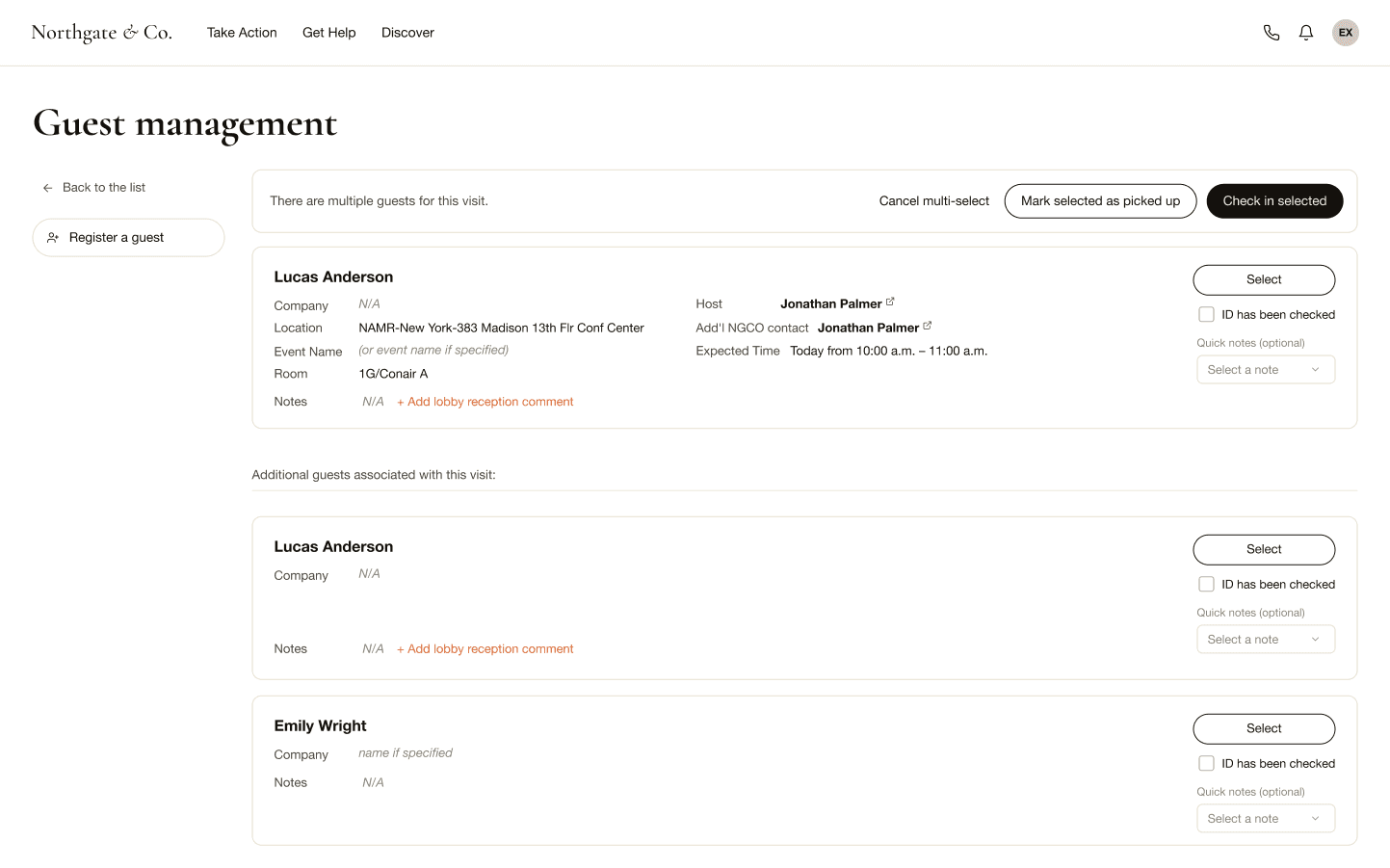

Screens represented for portfolio purposes. Confidential details abstracted.
Screens represented for portfolio purposes. Confidential details abstracted.
Pick up all and check in all
Pick up all and check in all
The way the feature is implemented are not able to be applied the way it currently is. I want to be intentionally adding the check ID the first step and one where you have to fufill. Doing Pick up all and check in all does not allow for this.
What I reimagined
This needed to be realigned with the current requirements of checking the ID in the system. Feel natural and feel like it won't really slow you down. Multiple selection becoming better adapted.
The foundation needs to be flexible. The wait, admit-in, check-out, each step configurable at the location level based on what that building actually has and needs. Admit is always present. Everything else toggles. even the Check ID.
The foundation needs to be flexible. The wait, admit-in, check-out, each step configurable at the location level based on what that building actually has and needs. Admit is always present. Everything else toggles. even the Check ID.
The foundation needs to be flexible. The wait, admit-in, check-out, each step configurable at the location level based on what that building actually has and needs. Admit is always present. Everything else toggles. even the Check ID.
THE DESIGN DECISION, ID check as the entry point
THE DESIGN DECISION, ID check as the entry point
We were told there would be no exceptions. We designed for them anyway. The ID check step carries a dropdown, host verified, no ID, child, or other with a free text field. Every selection is recorded. Every exception has a named reason. The system holds the decision so the staff member doesn't have to carry it alone.
We were told there would be no exceptions. We designed for them anyway. The ID check step carries a dropdown, host verified, no ID, child, or other with a free text field. Every selection is recorded. Every exception has a named reason. The system holds the decision so the staff member doesn't have to carry it alone.
The exceptions
The exceptions
Screens represented for portfolio purposes. Confidential details abstracted.
Screens represented for portfolio purposes. Confidential details abstracted.
The multiple selection from shelved to stronger
The multiple selection from shelved to stronger
The multiple selection from shelved to stronger
Early in the process I worked on a multiple selection feature, the ability for staff to select guests in bulk and move them to the next step. Leadership set it aside.
Then the development team showcased an idea. It sparked something in me. I kept working. What came back was better than the original.
Early in the process I worked on a multiple selection feature, the ability for staff to select guests in bulk and move them to the next step. Leadership set it aside.
Then the development team showcased an idea. It sparked something in me. I kept working. What came back was better than the original.
Early in the process I worked on a multiple selection feature, the ability for staff to select guests in bulk and move them to the next step. Leadership set it aside.
Then the development team showcased an idea. It sparked something in me. I kept working. What came back was better than the original.
THE DESIGN DECISION, ID check as the entry point
THE DESIGN DECISION, ID check as the entry point
The multiple selection isn't just a speed feature. It's a trust feature. A lobby staff member managing a full room during a high-volume event can move a group of 1,000 guests to the next step in one action, because the system has already done the verification thinking for them. Fast because it's safe, not instead of it.
The multiple selection isn't just a speed feature. It's a trust feature. A lobby staff member managing a full room during a high-volume event can move a group of 1,000 guests to the next step in one action, because the system has already done the verification thinking for them. Fast because it's safe, not instead of it.
01
Selection as a feature
Selection as a feature
I worked on the multiple selection because the dev team really came through with their ideas. So I went to work on it.
The new function here. Screens represented for portfolio purposes. Confidential details abstracted.
The new function here. Screens represented for portfolio purposes. Confidential details abstracted.
Why solves the issue
This give the exceptions and options to just check the ID, also undo allowing for errors.
This give the exceptions and options to just check the ID, also undo allowing for errors.
This give the exceptions and options to just check the ID, also undo allowing for errors.
The auto selection every time you check an ID.
The auto selection every time you check an ID.
The auto selection every time you check an ID.
Configurable wait guest, admit guest and check out guest. This allows for flexiblity for each building location with some admin features per site.
Configurable wait guest, admit guest and check out guest. This allows for flexiblity for each building location with some admin features per site.
Configurable wait guest, admit guest and check out guest. This allows for flexiblity for each building location with some admin features per site.
Finally tracking more at the lobby dashboard. Tracking these metrics, along with issues and the amount of guests we turn away.
Finally tracking more at the lobby dashboard. Tracking these metrics, along with issues and the amount of guests we turn away.
Finally tracking more at the lobby dashboard. Tracking these metrics, along with issues and the amount of guests we turn away.
This foundation that is stable, configurable, accountable was what made everything that followed possible. The lobby dashboard and guest detail view weren't separate projects. They were the next natural consequence of having something solid to build on.
This foundation that is stable, configurable, accountable was what made everything that followed possible. The lobby dashboard and guest detail view weren't separate projects. They were the next natural consequence of having something solid to build on.
Chapter 07 · New to the roadmap
What the foundation made possible
What the foundation made possible
With a stable, configurable foundation in place the next question became clear. The staff using this system every day deserved a better experience on top of it.
With a stable, configurable foundation in place the next question became clear. The staff using this system every day deserved a better experience on top of it.
With a stable, configurable foundation in place the next question became clear. The staff using this system every day deserved a better experience on top of it.
This wasn't on the roadmap. I made the case for it.
This wasn't on the roadmap. I made the case for it.
This wasn't on the roadmap. I made the case for it.
We were already making changes to the system. The research we had, from a single high-volume location and concept testing, was pointing at real friction. Staff were working around the tool, not with it. That was enough to push for an uplift.
We were already making changes to the system. The research we had, from a single high-volume location and concept testing, was pointing at real friction. Staff were working around the tool, not with it. That was enough to push for an uplift.
We were already making changes to the system. The research we had, from a single high-volume location and concept testing, was pointing at real friction. Staff were working around the tool, not with it. That was enough to push for an uplift.
The finding that changed the layout
The finding that changed the layout
Original screen
Original screen
The guest detail view, the screen that opens when a staff member clicks into a record needed to serve two people simultaneously. Jordan's speed and Marcus's precision. Different goals, same screen.
The before state had no hierarchy. Everything at the same visual weight. The redesign built hierarchy from the ground up and gave staff a collapsed and expanded state so they could choose between seeing more guests or more detail depending on the moment.
The two column layout was suppressing critical information — guest names truncated, details hidden behind a hover.
The two column view and hierarchy wasn't just a visual problem. It was an information problem. Removing it changed everything.
The guest detail view, the screen that opens when a staff member clicks into a record needed to serve two people simultaneously. Jordan's speed and Marcus's precision. Different goals, same screen.
The before state had no hierarchy. Everything at the same visual weight. The redesign built hierarchy from the ground up and gave staff a collapsed and expanded state so they could choose between seeing more guests or more detail depending on the moment.
The two column layout was suppressing critical information, guest names truncated, details hidden behind a hover.
The two column view and hierarchy wasn't just a visual problem. It was an information problem. Removing it changed everything.
The guest detail view, the screen that opens when a staff member clicks into a record needed to serve two people simultaneously. Jordan's speed and Marcus's precision. Different goals, same screen.
The before state had no hierarchy. Everything at the same visual weight. The redesign built hierarchy from the ground up and gave staff a collapsed and expanded state so they could choose between seeing more guests or more detail depending on the moment.
The two column layout was suppressing critical information — guest names truncated, details hidden behind a hover.
The two column view and hierarchy wasn't just a visual problem. It was an information problem. Removing it changed everything.
The guest detail view, the screen that opens when a staff member clicks into a record needed to serve two people simultaneously. Jordan's speed and Marcus's precision. Different goals, same screen.
The before state had no hierarchy. Everything at the same visual weight. The redesign built hierarchy from the ground up and gave staff a collapsed and expanded state so they could choose between seeing more guests or more detail depending on the moment.
The two column layout was suppressing critical information — guest names truncated, details hidden behind a hover.
The two column view and hierarchy wasn't just a visual problem. It was an information problem. Removing it changed everything.
THE DESIGN DECISION, no discovery, design first
THE DESIGN DECISION, no discovery, design first
Leadership approved concept and preference testing, not discovery research. I was a constraint in we had to work with The approach was to design from what we knew existing research, staff conversations, and a clear picture of where the current experience was failing. Then validate and iterate. Not ideal. But responsible given the context.
Leadership approved concept and preference testing, not discovery research. I was a constraint in we had to work with The approach was to design from what we knew existing research, staff conversations, and a clear picture of where the current experience was failing. Then validate and iterate. Not ideal. But responsible given the context.
02
The guest view hierarchy and control
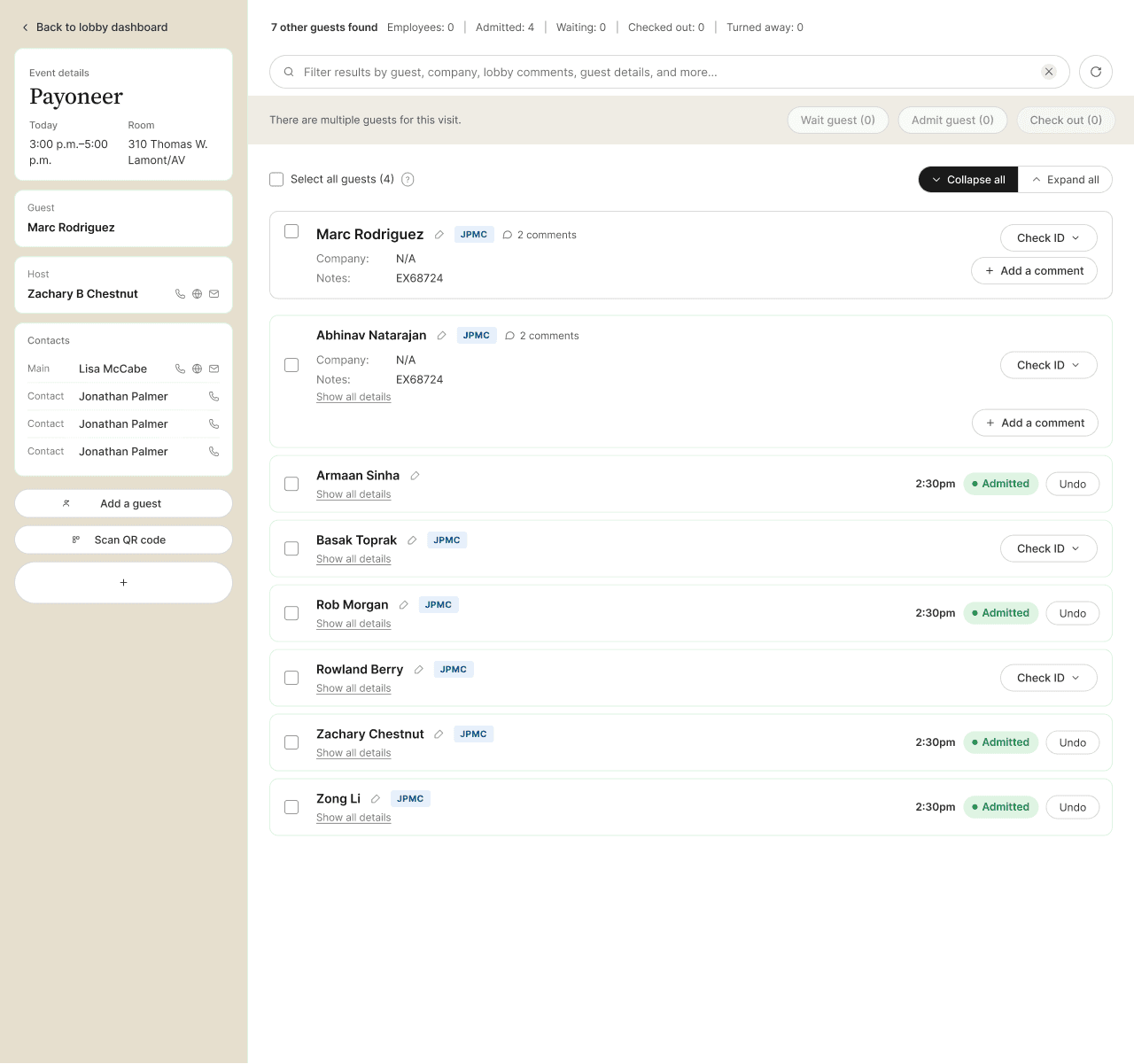
The issue here was around the hierarchy and control. It was flat and without hierarchy and doesn't give the lobby staff what they need to make decisions.
One of the redesigned layouts . Screens represented for portfolio purposes. Confidential details abstracted.
One of the redesigned layouts . Screens represented for portfolio purposes. Confidential details abstracted.
The screens and variations are currently in testing.
The screens and variations are currently in testing.
03
The configurable state
We made it so that whatever b building you were in, you can ultimately have a combination of check ID, Admit, and check out.
THE DESIGN DECISION, one column, more guests, full names visible
THE DESIGN DECISION, one column, more guests, full names visible
The collapse all and expand all was important. I help to give the different lobby staff the amount of information they need. The person who they clicked on is highlighted at the top and the associated guests. Then they can see more if they want to with these features. They can expand and collapse one at a time too. This a recreation and not the exact.
The collapse all and expand all was important. I help to give the different lobby staff the amount of information they need. The person who they clicked on is highlighted at the top and the associated guests. Then they can see more if they want to with these features. They can expand and collapse one at a time too. This a recreation and not the exact.
The collapsed view gives the lobby staff the ability to see everything at once with clutter.
The collapsed view gives the lobby staff the ability to see everything at once with clutter.

The expanded view gives the lobby staff the ability to see a more detailed view.
The expanded view gives the lobby staff the ability to see a more detailed view.
The preference testing returned a positive response — particularly around guest visibility and name legibility. The one known gap is field-level search: staff can search for fields not displayed in the grid, so results appear without context to confirm them. Scoped to a future iteration deliberately. Shipping a better foundation first was the right call.
Shipping a better foundation first was the right call.
The preference testing returned a positive response — particularly around guest visibility and name legibility. The one known gap is field-level search: staff can search for fields not displayed in the grid, so results appear without context to confirm them. Scoped to a future iteration deliberately. Shipping a better foundation first was the right call.
Shipping a better foundation first was the right call.
Chapter 07 · Impact — closING the loop
85% → 91%
85% → 91%
satisfaction rates from staff usage
But the feedback that stayed with me came from the staff.
But the feedback that stayed with me
came from the staff.
Cindy Schwartz
30 / Female
“The check in and out process, felt great. I feel like it doesn’t slow me down.”
Marcus S.
35 / Male
Receptionist, lobby
entrance.
Receptionist, lobby
entrance
"I feel like it doesn't take any longer to check in guests than it did before we added this additional step and feature." — Lobby staff, high volume location
Someone already thinking about how to make it better. That's the feedback that tells me the work landed.
Chapter 08 · Reflection
Reflection
The root cause wasn't a broken system. It was the absence of a shared process standard.
What surprised me most was understanding why the process had diverged across locations rather than how. Everyone was working in the same system but without a defined standard, locations had each found their own way through it. The design problem was real — but the root cause was the absence of a shared process.
If I were approaching this again I'd start that standardization conversation earlier — before the screens, before the feature requests. The foundation work would have been faster for it.
That's the question I'd bring into any system-level engagement earlier. Not what needs to be designed — but what process standard is missing underneath it.
What surprised me most was understanding why the process had diverged across locations rather than how. Everyone was working in the same system but without a defined standard, locations had each found their own way through it. The design problem was real — but the root cause was the absence of a shared process.
If I were approaching this again I'd start that standardization conversation earlier — before the screens, before the feature requests. The foundation work would have been faster for it.
That's the question I'd bring into any system-level engagement earlier. Not what needs to be designed — but what process standard is missing underneath it.
What surprised me most was understanding why the process had diverged across locations rather than how. Everyone was working in the same system but without a defined standard, locations had each found their own way through it. The design problem was real — but the root cause was the absence of a shared process.
If I were approaching this again I'd start that standardization conversation earlier — before the screens, before the feature requests. The foundation work would have been faster for it.
That's the question I'd bring into any system-level engagement earlier. Not what needs to be designed — but what process standard is missing underneath it.
Six months. One system. A foundation that didn't exist when I arrived.
10 · all works
work

DESIGN LEAD
•
ENTERPRISE
•
TEAM OF RESEARCH, PRODUCT AND DEVELOPMENT
JPMorgan Chase — Guest Management
Creating cross-functional rhythm on a 1M+ guest system.
90% satisfaction. Shared cadences where none existed.
1M+
GUESTS →

DIRECTOR OF UX
•
Team of 9
Connecting Mothers Initiative
Built a design function from scratch, leading a team of 9 to create a platform mothers could trust. Building 0 to 1.
9
MEMBER TEAM →

DESIGN LEAD
•
ENTERPRISE
•
FOUNDING DESIGNER
Ascend Cargo Systems
Physical security for 300K users, aligning firm compliance without fighting daily user experience.
1B+
First client valuation
10 · all works
work
DESIGN LEAD
•
ENTERPRISE
•
TEAM OF RESEARCH, PRODUCT AND DEVELOPMENT
JPMorgan Chase — Guest Management
Creating cross-functional rhythm on a 1M+ guest system.
90% satisfaction. Shared cadences where none existed.
1M+
GUESTS →
DIRECTOR OF UX
•
Team of 9
Connecting Mothers Initiative
Built a design function from scratch, leading a team of 9 to create a platform mothers could trust. Building 0 to 1.
9
MEMBER TEAM →
DESIGN LEAD
•
ENTERPRISE
•
FOUNDING DESIGNER
Ascend Cargo Systems
Physical security for 300K users, aligning firm compliance without fighting daily user experience.
1B+
First client valuation
10 · all works
other work
DIRECTOR OF UX
•
Team of 9
Connecting Mothers Initiative
Built a design function from scratch, leading a team of 9 to create a platform mothers could trust.
9
MEMBER TEAM →
DESIGN LEAD
•
ENTERPRISE
•
TEAM OF 15
JPMC — Guest Management
Creating cross-functional rhythm on a 1M+ guest system. 90% satisfaction. Shared cadences where none existed.
1M+
GUESTS →
10 · all works
other work
DIRECTOR OF UX
•
Team of 9
Connecting Mothers Initiative
Built a design function from scratch, leading a team of 9 to create a platform mothers could trust.
9
MEMBER TEAM →
LEAD
•
ENTERPRISE
•
TEAM OF 15
JPMC — Guest Management
Creating cross-functional rhythm on a 1M+ guest system. 90% satisfaction. Shared cadences where none existed.
1M+
GUESTS →
10 · all works
other work
IMAGE
DIRECTOR OF UX
•
Team of 9
Connecting Mothers Initiative
Built a design function from scratch, leading a team of 9 to create a platform mothers could trust.
9
MEMBER TEAM →
DESIGN LEAD
•
ENTERPRISE
•
TEAM OF 15
JPMC — Guest Management
Creating cross-functional rhythm on a 1M+ guest system. 90% satisfaction. Shared cadences where none existed.
1M+
GUESTS →